
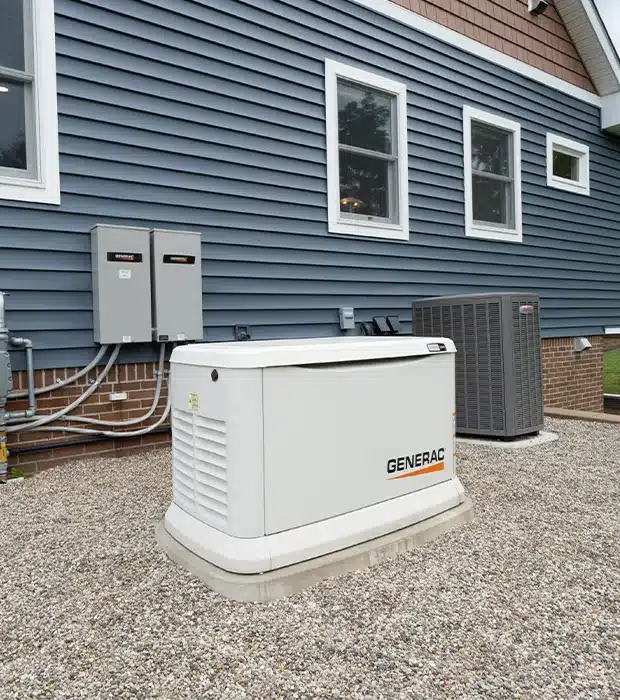
Power outages around metro Atlanta rarely give notice. One summer storm rolls through Dunwoody or Sandy Springs, and suddenly the refrigerator warms and the air conditioning falls silent. So the question we hear most is simple: what size generator do I need for my house? The answer depends on your wattage, appliances, and electrical panel, not square footage.
Why Guessing the Wattage Costs You Money
Most homeowners pick a generator by price, or by whatever the neighbor bought. That guess goes one of two ways, and both get expensive.
Undersize it and the unit overloads the second your air conditioner kicks on. You get tripped breakers, dimming lights, and stressed electronics during the hours you need power most.
Oversize it, and you pay thousands more upfront, then burn extra fuel every hour it runs. Running far below capacity can also wet the engine.
That is why how many watts do I need to run my house is the real question behind generator shopping.
How Generator Sizing Actually Works
When homeowners ask what size generator do I need for my house, we start with two numbers instead of one.
Running Watts vs Starting Watts
Every appliance has a running wattage that keeps it operating, and a starting wattage, sometimes called surge watts, for the spike when a motor turns on.
Motors are the troublemakers. Your refrigerator may draw 700 watts, but demand can reach close to 2,000 watts at startup.
The rule we use is simple. Add the running watts of everything you want powered at once, then add the single largest starting figure.
Build Your Own Load List
Before hunting for a generator wattage chart, walk your home and write down what matters when the lights go out.
A refrigerator draws 600 to 800 running watts, a gas furnace blower 600 to 800, a sump pump around 800, and a 3-ton central AC roughly 3,500 running watts, plus a higher surge.
Electric appliances change math fast. An electric water heater pulls about 4,500 watts, and an electric range can pull 8,000 to 12,000 watts alone.
Common Generator Sizes for Atlanta Area Homes
7,500 to 10,000 Watts: Essentials Only
This range covers a refrigerator, lights, Wi-Fi, a furnace blower, a sump pump, and a few outlets. It fits smaller Brookhaven or Chamblee homes with gas heat and gas water heating.
It usually does not have central air conditioning, which matters in a Georgia August.
12kW to 18kW: The Comfortable Middle
Most 2,000 to 3,000 square foot homes in Dunwoody, Roswell, and Alpharetta land here. This range usually supports one AC system, kitchen circuits, and daily essentials together.
If you are weighing a standby generator vs. a portable generator, this is where a permanent standby unit starts to make sense.
20kW to 26kW: Close to Whole Home
Homeowners often ask us, will a 22kW generator run my whole house? For many homes with two HVAC systems or heavier electric loads, yes, especially with smart load management.
Larger properties in Johns Creek or East Cobb with electric ranges, hot tubs, and EV chargers may need more capacity, or load shedding instead.
What Changes Your Number
Fuel type matters most. Gas heat, gas water heating, and a gas range cut demand dramatically compared with an all-electric home.
Add-ons stack up fast. A well pump, pool pump, second refrigerator, or EV charger can each push you into the next size class.
Your panel matters too. If your service is already near capacity, determining what size generator you need may also involve a panel upgrade.
The Real Solution: A Load Calculation, Not a Guess
We do not eyeball this. A licensed electrician performs an electrical load calculation using your panel, circuits, and appliance nameplate ratings, following the National Electrical Code that Georgia adopts.
Two identical-sized homes can differ by 8,000 watts in appliances alone, so measured numbers beat online estimates. A professional load calculation makes choosing the right generator size much easier by showing exactly how much capacity your home actually requires.
Then comes the step people skip. Any generator feeding hardwired circuits requires proper transfer switch installation so that utility power and generator power never meet.
Backfeeding through a dryer outlet is illegal and can injure the lineman restoring power to your street. A code-compliant interlock or transfer switch removes that risk.
The Payoff of Sizing It Right
You protect your equipment. Correct sizing holds voltage steady, which shields your HVAC system, appliances, and anything plugged into a wall.
You spend less. Right-sizing avoids paying for capacity you never use and fuel you never need to burn.
You stay safe and legal, since permitted work with a proper connection keeps your insurance intact and your household out of danger.
Best of all, when the next storm hits the block, your house keeps running.
Frequently Asked Questions
Most homes need 12kW to 18kW for essentials plus air conditioning, though electric appliances and second HVAC units push that higher.
Rarely. Portable units usually max near 8,500 watts, enough for essentials but not central air, water heating, and kitchen circuits together.
Yes. Connecting a generator to home wiring requires permitted work by a licensed electrician, plus inspection, to satisfy local code requirements.
Sometimes. Older or full panels often need an upgrade or subpanel before a transfer switch can be installed safely.
Frequent breaker trips, flickering lights, or the unit bogging down when your air conditioner starts all point toward insufficient capacity.
Ready to Size It Right? Let Us Run the Numbers for You
Stop guessing and start with facts about your own home. If you have been asking what size generator you need for your house, we will give you a straight answer based on your panel, appliances, and measured load.
We have served Dunwoody, Sandy Springs, Alpharetta, Roswell, and Brookhaven since 2004, and every recommendation comes with upfront pricing and zero pressure.
Call Bray Electrical at 770-525-3979 or book online today. Let us handle the load calculation, panel work, and safe connection, so your next outage is just a quiet evening.


